
Does TRE™ Work Online? What Actually Changes on a Screen
You’re considering an online TRE™ session and wondering whether something gets lost over a screen. Here’s what actually changes when you practise at home, what an online session can’t give you, and who is better off with someone in the room.
Yes, TRE™ (Tension and Trauma Releasing Exercises) works online, and the reason is simpler than most people expect: the tremor comes from your own body, not from my hands.
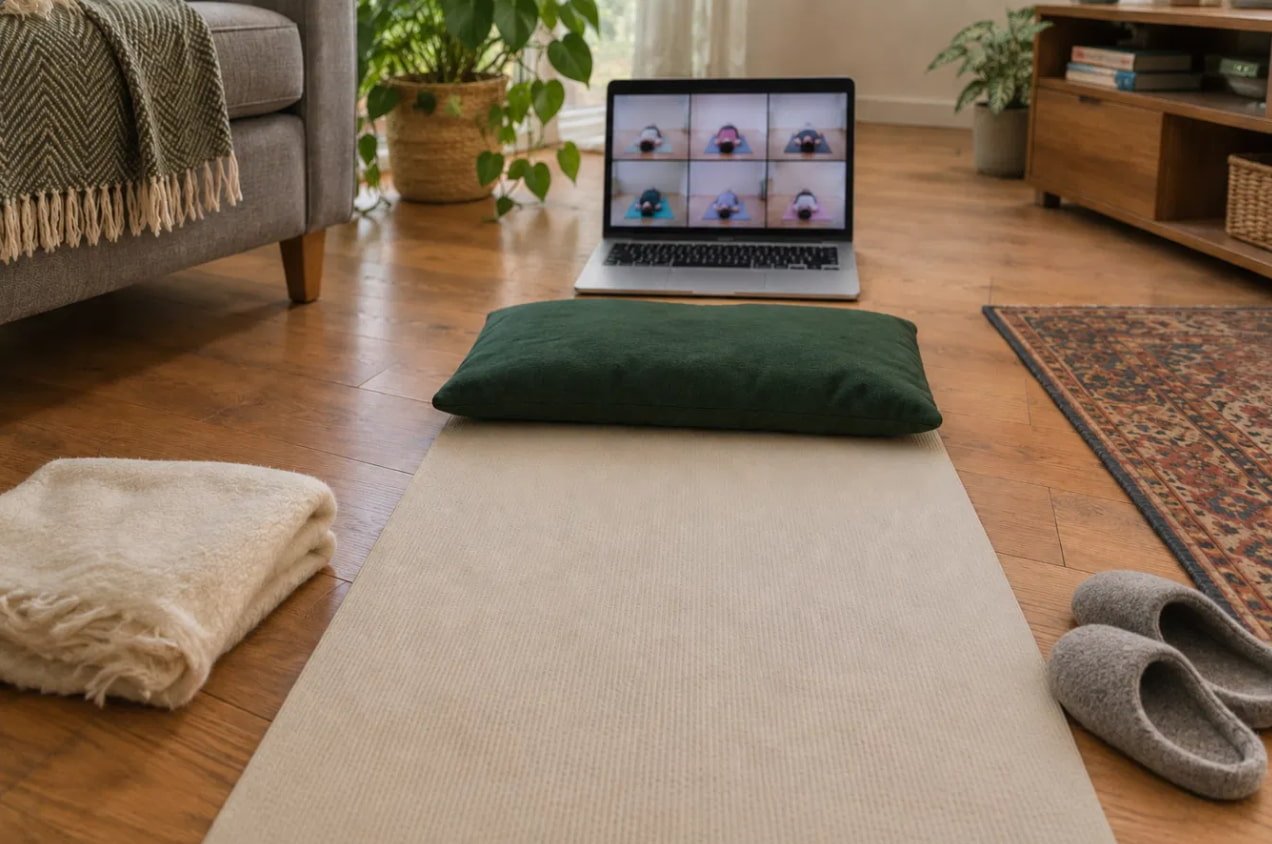
In person I sometimes use touch, but TRE doesn’t depend on it. My work is to guide you and to watch what happens, and that part stays the same whether I’m in the room with you or on a screen. Nothing has to physically cross the distance for your body to do what it already knows how to do. That’s also how my private TRE sessions work: live, on video, with you lying on the floor of your own room.
That’s the short answer. The longer one is more interesting, because something does change when you practise at home, just not the thing people usually worry about.
What an online session can’t give you
I can’t hold your hand, and I can’t sit beside you and put a hand on your shoulder when something old comes up. Physical presence is real, and an online session doesn’t replace it.
But that doesn’t make online the worse option. An online session has its own quality, and some of that quality is only possible because you’re at home. I think it’s fairer to say this at the start than to pretend for the rest of the page that the difference isn’t there.
Where TRE sits among the tools
Most body-based work needs someone else: a massage therapist’s hands, an osteopath’s adjustment, something that arrives from outside and is done to you. Talk therapy needs words, so you describe, you explain, and you try to find language for what happened.
TRE needs neither. The shaking is a reflex your body already carries, the same one animals use after danger has passed. You do a few exercises, the muscles get tired, and at some point the tremor starts on its own. How TRE works in the body goes into the mechanism properly, but the part that matters here is that there is no outside intervention and no talking required.
That’s quite an unusual place among healing methods, and it’s exactly why TRE travels over a screen when most body work doesn’t. The method was developed by Dr. David Berceli, whose organisation, TRE For All, certifies providers worldwide.
What changes when you’re in your own room
When I’m in a room with someone, they orient toward me. It’s subtle and nobody does it on purpose: a glance to check whether this is going right, a small adjustment of the body. Nervous systems that are near each other tend to arrange themselves around one another, and that’s not a problem, it’s simply what happens.
At home that pull is smaller, and people move more like themselves. The small details, how they shift, when they pause, what they do with their hands between the exercises, belong more to them and less to the room we’re both in. I notice it often enough that I no longer think of online as the compromise version.
What I can miss on a screen
There are three things, and I’d like you to hear them from me now rather than discover them halfway through a session.
Framing. If the camera only catches your legs, I lose your breathing and your face, and that’s one of the main things I read. It doesn’t stop the session, and I have worked that way, but I ask more and see less.
Very small tremors. Some bodies tremor very faintly, more like an inner vibration than a visible movement, and on a screen I sometimes can’t see it at all, especially with baggy trousers in colours that blend with the surroundings. So I ask, and if you tell me it’s small and internal, that’s information I couldn’t have got any other way.
Sound. This one catches people out. You lie down, the laptop is two metres away, and your voice gets thin, usually at exactly the moment something comes up and you want to say it out loud. Wireless headphones solve this almost completely.
Which is why the setup matters
None of this is fussiness about equipment, it’s just that each choice has a consequence. A camera placed where your whole body fits in the frame gives me more to work with, and a stack of books at the far end of the mat usually does the job. If the light is behind you, you become a silhouette and I lose your face again, while light from the front or the side keeps you visible. Headphones, if you have them, mean I can hear you when you’re lying down.
And if none of that is possible on a given day, we still work. I ask more questions and you tell me more, and that’s a real option, not a fallback I’m being polite about.
What you need in the room
For an online session
Enough floor space to lie down and stretch your arms out, a wall for exercise six, the wall sit, and something soft underneath you, like a mat, a blanket or a carpet. Clothes you can move in are best, with bare feet or socks, whichever you prefer.
Warmth matters more than people expect. A body that lies still and tremors cools down, and cold tends to bring the tremor to a stop, so a blanket within reach is usually enough.
What happens after
When the session ends, you’re already home. You don’t have to gather yourself, put your shoes on and walk out into the street, or sit on public transport or drive while your system is still settling. You can lie there for another half hour and do nothing at all, because the integration continues in the quiet afterwards, and at home nothing interrupts it. After an in-person session, that hour usually gets spent on the way home.
Stopping, slowing, changing your mind
The tremor stops when you stop it. Straightening your legs, rolling onto your side or simply standing up brings it to an end, and this is true whether I’m in the room or not. Some people want to know that before they begin, which is completely reasonable, because knowing you can end something is often what makes it possible to start.
We also don’t have to go the full length. Sessions can be shorter, slower, with more pauses, and that’s yours to decide as we go. If you’d like the fuller picture of what the shaking can bring up, and who goes more slowly, it’s in Is TRE safe?.
When something interrupts
The connection drops, someone knocks on the door, or a delivery arrives at the least convenient moment. None of this is a problem: you stop, you handle whatever it is, and we reconnect and pick up where we left off.
TRE is a self-regulation process, so it can be interrupted and resumed without anything being lost. There’s even something useful in it, because stopping when life interrupts is the same skill as stopping when the tremor becomes more than you want, and you practise it either way.
The camera question
Some people don’t want to be watched while they shake, and I think that’s worth saying out loud, because most people won’t say it. In private sessions it rarely comes up, because people who book one usually want me to see them. The worry is more common before a group session, where other people are on the screen too.
There are options. The camera can sit further back, the light can be low, and for part of the session or all of it the camera can be off and we work by voice alone. Then I ask more, and you tell me what you’re noticing.
In a small group, people see each other when we share at the beginning and at the end, but while the shaking happens nobody is really looking at the screen, because everyone is in their own process. I still check in with each person by name.
A guided session and a video on your own
There are a lot of TRE videos online, and many people start there, which I think is completely fine. The exercises in the videos are the same ones we do in a session. What a guided session adds is everything around them: you learn the exercises properly, you understand what is happening in your body and what can come afterwards, and you learn how to ground yourself when you need it. And there is co-regulation, which simply means that your nervous system settles more easily when someone calm is with you, even through a screen.
It also helps, in a very practical way, that someone is watching. On your own it’s easier to dissociate, to disconnect from your body and from what you feel, or to miss the moment you become activated and your nervous system shifts into a stress response, and then you don’t really know what’s happening to you.
I remember one client who tried TRE with videos on her own before she came to me. She didn’t understand what was happening in her body, and she worried she was doing it the wrong way, because there was nobody to tell her. Different videos show different kinds of shaking, so the more she watched, the more confusing it got. She was also afraid of losing control. That’s why she came to me: she wanted someone who knows the method to watch her and tell her what they see.
When online is the only door open
I worked with a woman I’ll call Maria. The details are changed, but the shape of the story is true.
Leaving her home wasn’t possible for her, partly for physical reasons and partly because of the kind of frozen state where the outside world has become too much to face. Going to a practitioner’s studio wasn’t a smaller version of her problem, it was the problem.
So online wasn’t second best for her, it was the only form of this work she could reach. She lay down on her own floor, in her own room, and her body did what bodies do. When people ask me whether online is as good as in person, I sometimes think of her, and of how strange that question sounds from where she was sitting.
Who does better with someone in the room
Some nervous systems need a lot of co-regulation, and not a face on a screen but a person sitting nearby, breathing steadily, physically there. If that’s what your system settles with, being in the room with a provider will probably serve you better, and I think that’s worth knowing before you book anything, including with me.
If we do work online anyway, I change the shape of the session: slower, with much more time for grounding and coming back to the present, less activation and more settling. The structure bends around what’s needed. If you’re not sure which one you are, what your nervous system does under stress may help you recognise your own pattern.
Frequently Asked Questions
Yes. The tremor is generated by your own body, and the method doesn’t rely on touch. What changes is what your provider can observe and what you get afterwards, not whether the mechanism works.
No. A full-body view gives your provider more to work with, but sessions can be done with the camera further back, in low light, or off entirely, with more spoken check-ins instead. In private sessions this rarely comes up. The worry is more common in a group, though while the shaking happens nobody is really looking at the screen.
Floor space to lie down and stretch out, a wall for the wall sit, something soft underneath, clothes you can move in, and something warm nearby. Wireless headphones help your provider hear you once you’re lying down.
Emotion surfacing during or after TRE is common. Your provider stays with you on the call, slows the session and moves toward grounding. You can also stop at any point, because ending the tremor is always available to you.
Yes. Straightening your legs, rolling onto your side or standing up ends the tremor. How you practise stopping and slowing down depends on what you need.
For most people, yes. TRE is a self-regulating process with no outside manipulation, which is why it transfers to video. Some health conditions call for a slower pace or a conversation first. Is TRE safe? covers them, and we talk about your health history before the first session.
More questions are answered in 27 common questions about TRE.
If you’re still deciding
I can’t tell you from here which format suits your body. What I can do is talk with you for thirty minutes, in English or Ukrainian, without you committing to anything, and that’s what the free 30-minute call is for. You describe what’s going on, I tell you what I think, and if what I think is find someone near you, I’ll say that.
If you’d like to read about the sessions first, they’re all described on the online sessions page.
Still deciding?
A free call, no commitment
Thirty minutes to talk about what’s going on, in English or Ukrainian. If I think someone near you would serve you better, I’ll tell you.