
How Does TRE® Work? A Simple Guide to the Science
Discover how your body’s natural healing mechanism helps you release stress, tension, and trauma through gentle, neurogenic tremors — and how TRE® works with your nervous system to bring you back to a state of calm and ease.
What Is TRE®?
Find out how your body’s natural healing mechanism helps you release stress, tension, and trauma through gentle tremors. Whether you’ve experienced something deeply distressing, or your body simply tightens up after a stressful day, TRE® is a practice that helps relax that tension. These exercises engage the body’s natural neurogenic tremor — a built-in reflex that allows the deeper, hidden patterns of stress, accumulated over years, to release.
TRE® stands for Tension & Trauma Releasing Exercises, a revolutionary approach developed by Dr. David Berceli. These simple exercises activate the body’s natural tremor reflex, allowing it to discharge stress that has been stored deep within the muscles and nervous system over time.
Learn how TRE® gives your nervous system permission to do what it was always designed to do — shake off stress and return to a state of calm and harmony.
The Science: Freeze, Fight & Flight
To understand how TRE® works, it helps to look at how your nervous system responds to stress or danger. Much like a complex alarm system, the body reacts instantly to a perceived threat — though sometimes the alarm stays “switched on” long after the danger has passed.
Our ancestors survived precisely because their bodies trembled after a threat. Whether an animal trembles after danger, or your body wants to shake after fear — these tremors are a natural way to discharge tension. TRE® uses this same biological reflex, which activates the body’s instinctive healing patterns to release stress that has built up over years.
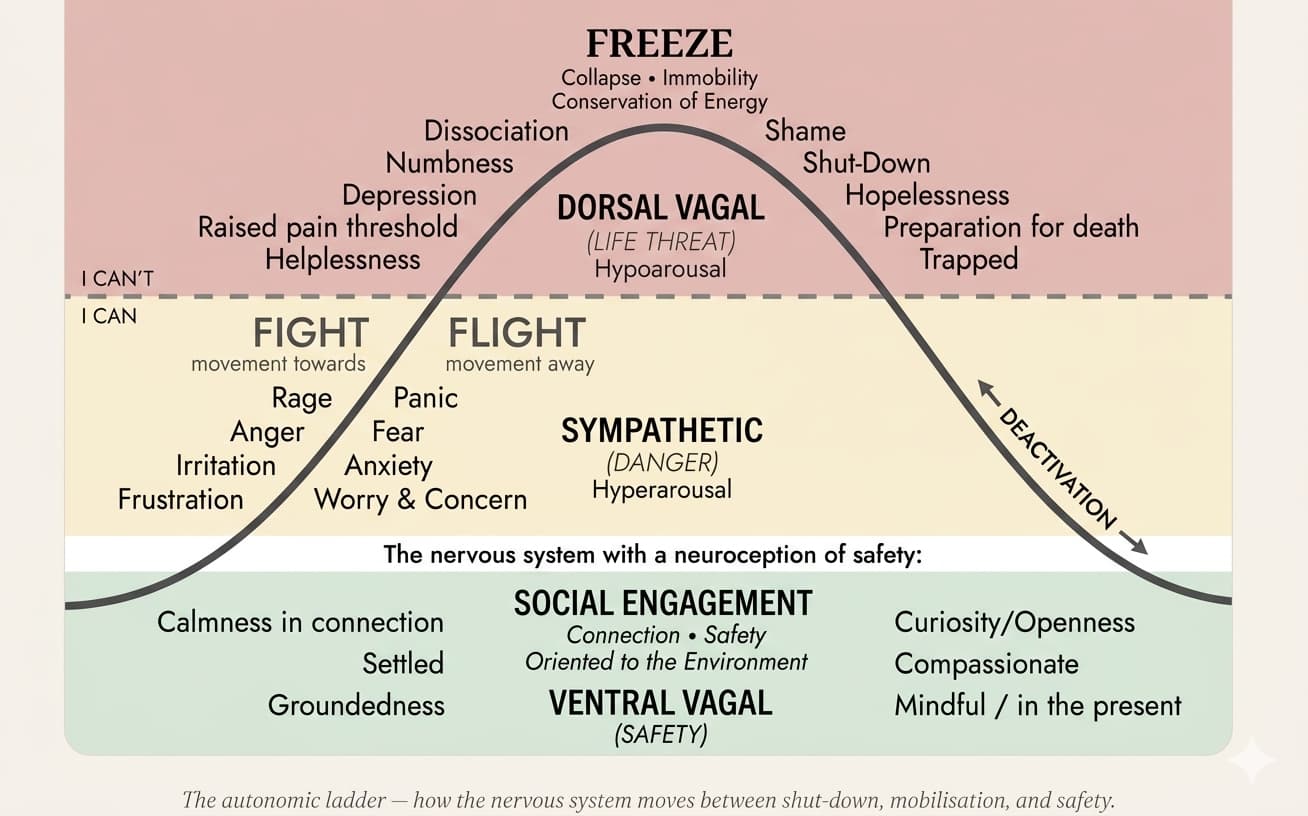
Numbness, depression, helplessness, raised pain threshold, hopelessness, a sense of being trapped. The body’s deepest protective state — “I can’t.”
Fight & flight: rage, anger, irritation, frustration, fear, panic, anxiety, worry. The mobilised, energised survival state — “I can.”
The autonomic ladder — how the nervous system moves between shut-down, mobilisation, and safety.
The Chemical Cascade of the Stress Response
When your brain perceives a threat — whether real or imagined — the hypothalamic-pituitary-adrenal (HPA) axis activates. This is the body’s command centre for managing stress, and it sets a precise chain of events in motion.
The Alarm Signal
- The amygdala fires an emergency signal
- Adrenaline and noradrenaline release into the bloodstream
- The sympathetic nervous system takes control
- Cortisol prepares the body for prolonged exertion
Fight — The Combat Response
When the body prepares to confront a threat, physiology shifts:
- Heart rate climbs (to 120–180 beats per minute)
- Blood is redirected to the muscles and brain
- Breathing quickens and becomes shallow
- Muscles tense — especially in the arms, hands, and jaw
- Pain threshold rises
- Pupils dilate and vision sharpens
- Digestion pauses — appetite disappears
Flight — The Escape Response
The body prepares to run:
- Blood floods the leg muscles (strength can increase by up to 300%)
- Sweating increases, breathing becomes more rapid
- Stress hormones peak
- Fine motor skills decrease as the body prioritises escape
- Attention narrows and focuses on the routes out
Freeze — The Immobilisation Response
When neither fighting nor fleeing is possible:
- The parasympathetic nervous system dominates
- Heart rate drops (sometimes dramatically)
- Breathing becomes very shallow, or holds altogether
- The body enters a state of extreme tension or numbness
- Dissociation may occur — a feeling of being “outside” the body
- Muscles contract and stiffen — immobilisation
- The sense of time becomes distorted
The Metabolic Aftermath
After these survival responses, the body has to process the chemical cocktail left behind:
- Cortisol may stay elevated for hours, even days
- Lactic acid accumulates in tensed muscles
- Inflammatory markers rise
- Neurotransmitter balance is disrupted
- Immune function is temporarily suppressed
When Stress Gets Stuck
In modern life, these responses are often triggered without ever completing their natural cycle. The nervous system can no longer distinguish between a sabre-toothed tiger and a demanding boss. Constant pressure — deadlines, conflict, intrusive thoughts, information overload — leaves us in a state of chronic stress.
The Consequences of Chronic Stress
- Persistently high cortisol — sleep problems, anxiety, irritability
- Reduced heart rate variability — cardiac strain
- Disturbed delivery of oxygen and nutrients to tissues
- Chronic muscle tension, especially in the neck, shoulders, and jaw
- Persistent inflammation and a higher risk of illness
- A constant feeling of being keyed up, yet exhausted
Where Tension Is Stored
Stress accumulates in specific zones of the body:
- The psoas muscle — the deep core of the body, which contracts to brace for survival. Chronic tension here affects posture, breathing, and the storage of emotional memory.
- The fascia — the connective web that holds the body together also holds patterns of tension, like a tightly wound spring.
This is why working with the body — rather than the thinking mind alone — can release years of accumulated tension that talking has never reached.
What Happens in the Body During TRE®
When you practise TRE®, something beautiful happens: the body completes the stress cycles it never had the chance to finish, through its own natural, neurogenic tremor.
The Stages of a TRE® Session
- Fatigue — a specific sequence of exercises gently tires the muscle groups, especially in the legs and core
- Activation — the body’s natural tremor begins
- Release — the tremor discharges accumulated tension
- Integration — the nervous system returns to balance and self-regulation
How the Tremor Feels
- Soft vibration or trembling that feels comfortable and natural
- A sense of release and reconnection with the body
- Sometimes warmth spreading through the body
- Possibly emotional release — tears or laughter
- A feeling of lightness afterwards
This is a fully self-regulated process: you tremor only for as long as is right for you, and you can stop at any moment by simply resting your feet flat on the floor.
The Life-Changing Benefits of TRE®
Physical:
- Reduced muscular tension and chronic pain
- Better quality of sleep
- Improved flexibility and ease of movement
- Lower cortisol and reduced stress
- Strengthened immunity
Emotional & Mental:
- Less anxiety and overwhelm
- Greater emotional stability
- Improved stress resilience
- A deeper sense of calm and wellbeing
- A stronger connection to yourself
For the Nervous System:
- Release of trauma and tension
- Restored balance in the nervous system
- Improved capacity for self-regulation
- A deeper, more reliable sense of inner safety
How to Begin Your TRE® Practice
The TRE® sequence begins with six standing exercises that gradually activate and gently fatigue the legs — waking up the feet and ankles, building warmth through the calves and thighs, and bringing a soft, sustained tension into the lower body. The seventh and final exercise is done on the floor, where the body settles into a supported position and the natural tremor is invited to begin. From there, you simply allow the tremor to build and move through you at its own pace, resting whenever you need to.
You can read the complete step-by-step breakdown — with photos and timing for every movement — in our full guide to the 7 TRE® exercises.
Important Guidelines
- Begin slowly and listen to your body
- Never force the tremor — it should always feel natural
- Practise in a safe, comfortable space
- Pay attention to your breath, resting after each session
- Work with a qualified TRE® provider when you’re starting out
Who TRE® Is For
The practice of TRE® can support almost anyone, including those with:
- Chronic stress or burnout
- Post-traumatic stress (PTSD)
- Anxiety and panic attacks
- Chronic pain
- Sleep difficulties
- High-pressure or physically demanding work
- Tension held from past physical activity
TRE® is accessible to the vast majority of people. That said, if you have a serious medical condition or are working through complex trauma, it is best to begin with a certified provider.
Finding Support: Working With a TRE® Provider
Although you can learn the basic exercises from articles like this one, working with a certified TRE® provider offers:
- Correct technique and proper orientation
- A personalised pace, adapted to your responses
- Support for emotional reactions, should they arise
- Safety and reassurance throughout the process
- A deeper understanding of your own tremor patterns
Make TRE® part of your life
- Begin with sessions of 15–20 minutes, 2–3 times a week
- Find a calm, private space to practise
- Keep a simple journal of how each session feels
- Stay present with the body, noticing without judging
- Pair it with other healing practices — meditation or gentle yoga
Your Body Knows How to Heal
TRE® is a reminder that your body holds an innate wisdom and a capacity for self-healing. Sometimes all our conscious mind needs to do is step aside and give that natural process room to work.
Whether you are working with deep, long-held trauma, TRE® offers a gentle, effective path to release the tension your body has carried for years. Your nervous system already knows how to return to calm — TRE® simply gives it permission.
Ready to discover your body’s own wisdom? Find a certified TRE® provider in your region, or simply begin — and let your nervous system show you the way.
Frequently Asked Questions
TRE® stands for Tension & Trauma Releasing Exercises — a series of simple movements developed by Dr. David Berceli that activate the body’s natural neurogenic tremor to discharge stress and tension stored in the muscles and nervous system.
Yes. The neurogenic tremor is a natural, self-regulated reflex that the body uses to release tension — the same mechanism animals use instinctively after a stressful event. You remain in control at all times and can stop the tremor whenever you choose by resting your feet flat on the floor.
Many people use TRE® as a body-based tool for calming the nervous system, lowering cortisol, and easing the physical symptoms of chronic stress and anxiety. It is a self-help practice and not a substitute for medical or psychological treatment; if you are managing a diagnosed condition, work alongside your healthcare provider.
When learning, sessions of 15–20 minutes, two to three times a week, are ideal. Integration time matters — more is not better when you are starting out. A certified provider can help you find the rhythm that suits your nervous system.
You can learn the basic exercises independently, but working with a certified TRE® provider first is strongly recommended — especially if you have a history of trauma, a medical condition, or you are new to body-based practice. A provider ensures correct technique, a personalised pace, and support if strong responses arise.
Ready to experience TRE®?
Practise with guidance
Reading about TRE® and experiencing it are two completely different things. A free 30-minute call with Anna is the simplest next step — no commitment, no pressure, just an honest conversation about what you need.