
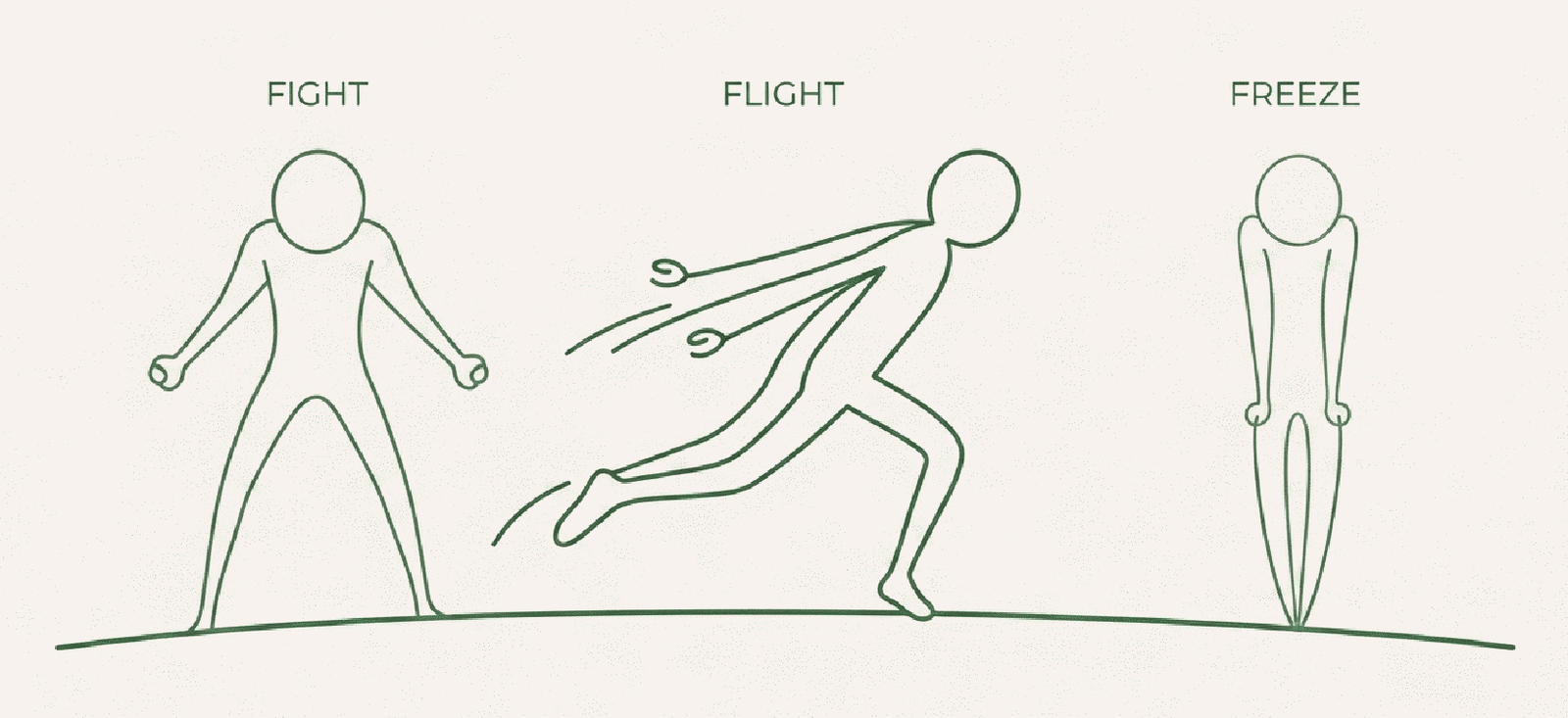
Fight, Flight, Freeze: What Your Nervous System Does Under Stress
Your heart can race before you have decided to be afraid. Here is a plain look at what your nervous system is actually doing when a threat hits, and how it finds its way back to calm.
The fight-flight-freeze response is your body’s automatic reaction to a threat. Fight means confront it. Flight means get away. Freeze means go still. You don’t choose any of it. It happens on its own, faster than thought, to keep you safe.
You know the shaky feeling after a difficult phone call? Or the way your heart pounds before you speak in front of people? That’s this same system at work. It reads danger and gets the body ready before you’ve had a chance to think. By the time you understand what’s happening, your body has usually already responded.
This is what it’s doing, and why.
Your nervous system, in plain terms
Your nervous system is the body’s messaging network. It carries signals between your brain and the rest of you.
Part of it you control. Lifting your arm, for example.
Part of it runs on its own. Your heartbeat. Your breathing. The stress response. You don’t have to think about any of it. It just happens.
That automatic part has two sides. One speeds you up. One calms you down. They take turns, all day, without you noticing.
Three brains, one job
It helps to picture the brain in three rough layers. This is a simplified map rather than exact anatomy, but it makes everything else easy to follow.
The thinking brain is the outer layer, the cortex. It plans, reasons, imagines, weighs choices. It’s clever, and it’s slow.
Underneath sits the emotional brain. It handles feelings and memory, and it’s always scanning in the background: is this safe, or not? It works faster than thought.
Deepest of all is the survival brain, the oldest part, sometimes called the reptilian brain. It runs your heartbeat, your breath, and the instant response to danger. It has no words and no sense of time. It’s the fastest of the three, and in a real threat, it’s the one in charge.
When something feels dangerous, the order flips. The slow thinking brain steps back. The fast survival brain takes over.
What happens in your body when a threat hits
Say something happens. A car swerves toward you. A voice turns sharp. Your survival brain reads threat and acts at once, before a single clear thought has formed.
It doesn’t wait for the thinking brain. Waiting takes time, and time could cost your life. So it sends the alarm straight to the body.
The body releases stress hormones: adrenaline first, for the instant surge, then cortisol to keep you going. Your heart speeds up. Your breath quickens. Blood moves out to the big muscles of your arms and legs, ready to run or fight. The colour can drain from your face as blood leaves the surface of the skin.
At the same time, whatever isn’t needed right now gets turned down. Digestion slows. Your mouth goes dry. Energy pulls away from the quiet background jobs and goes where survival needs it.
Now the body is ready: to fight, to flee, or, if neither seems possible, to freeze.
The message to the thinking brain comes later, and quieter. In that moment you don’t need to analyse, you need to move. So the reasoning part comes back online a beat behind the rest.
That’s why you often act before you understand. And why the understanding can arrive late: the hands that start shaking once it’s over, the “what just happened” that only lands after you’re already safe. Nothing malfunctioned there. Your body simply put survival first and explanation second.
The gas pedal: the sympathetic nervous system
The sympathetic nervous system is the accelerator. It gets you ready to act.
When it switches on, a lot happens at once. Your heart beats faster. Your breath quickens. Your muscles tense. Your senses sharpen. Blood moves to your arms and legs, ready to move.
You’ve felt this. A near-miss in traffic. Standing up to speak. The moment before hard news. That surge is the sympathetic side doing its job.
What it can feel like
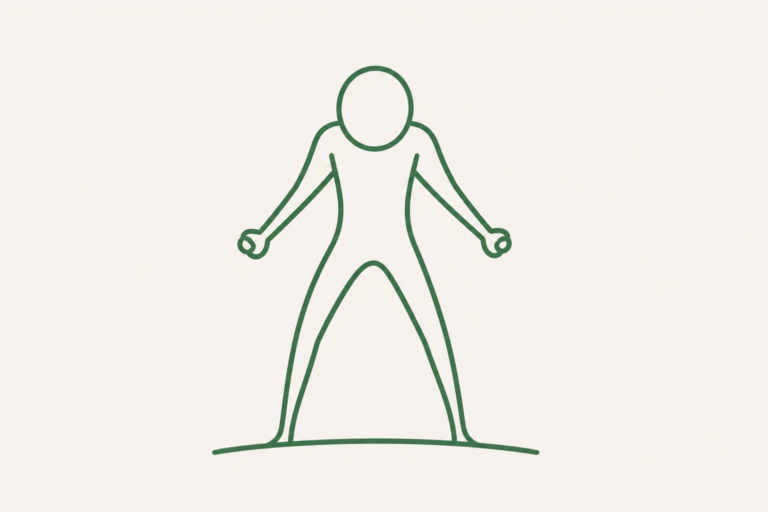
You won’t notice all of it, and you don’t need to. But this is the kind of thing going on:
- breath fast and high in the chest
- heart pounding, pulse quick
- skin pale, hands cold or clammy
- mouth dry, stomach churning
- muscles tight, especially the ones that curl you inward
- senses sharp, pupils wide, easily startled
Emotionally it can arrive as anxiety or panic, a flash of fear or anger, everything moving too fast at once. That “too much, too fast” feeling is the system working, not a sign you’re doing anything wrong.
Fight and flight: same fuel, different direction
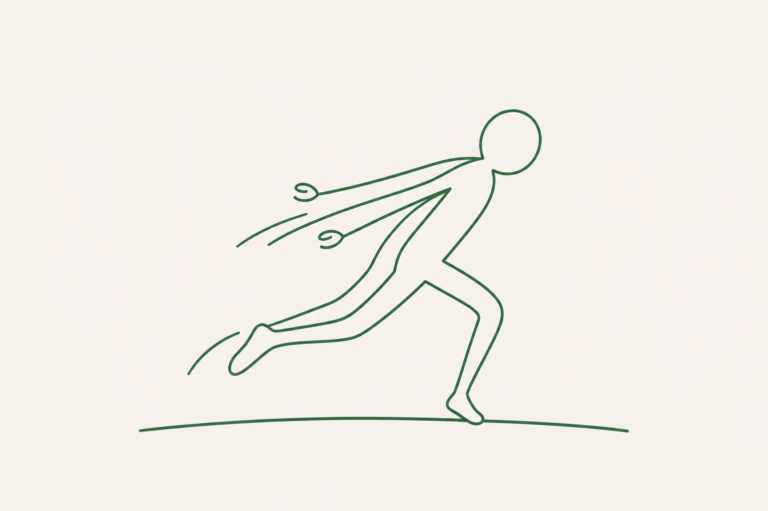
Fight and flight run on the same fuel. Same racing heart, same rush.
The difference is where it points. Fight leans in, toward the threat. Flight pulls away, toward escape. Your body picks in a split second, based on what feels survivable. Same energy, aimed two ways.
The freeze response: when the body goes still
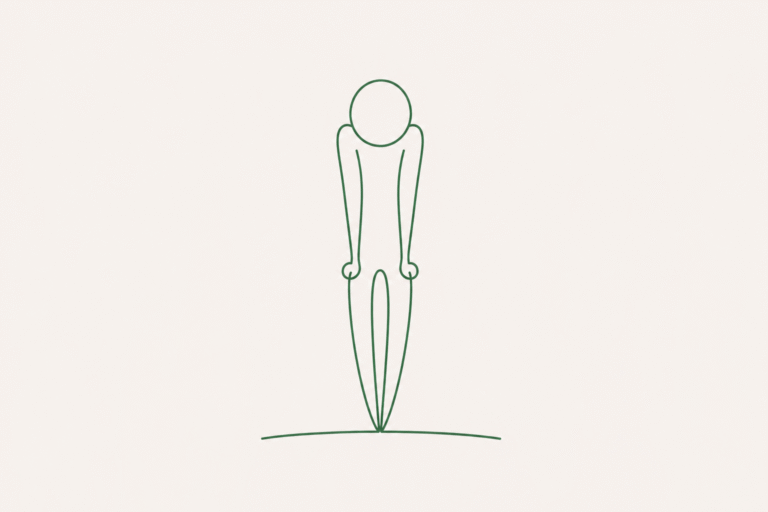
Sometimes fight and flight don’t feel possible. The threat is too big, or there’s nowhere to go. So the body does something else. It goes still.
Freeze is run by a different, older branch of the system. When your body decides that fighting and fleeing won’t work, it drops into a deep, ancient kind of protection and powers down. The heart can slow. Muscles go limp. You might feel numb, heavy, far away, as though you’re watching yourself from outside.
You may recognise the milder end of this: the mind going blank, time slowing, a sense of not quite being here. At the stronger end, some people feel disconnected from parts of the body, or oddly calm and beyond pain. It can be frightening, and it can also feel strangely peaceful. Either way, it isn’t a choice, and it isn’t weakness. It’s the oldest survival card the body holds. Animals do it too: a predator often loses interest in prey that has gone completely still.
Researchers who study freezing describe it as alert stillness rather than shutdown, the body paused and paying close attention, ready to move the moment it can. If you’d like the detail, here’s the research on the freeze response.
The brake: the parasympathetic nervous system and the vagus nerve
The parasympathetic nervous system is the brake. After a threat passes, it brings you back down. This is the rest-and-digest side. The part that lets you settle, eat, sleep, recover.
The vagus nerve: the body’s calming cable
The vagus nerve is the main pathway this calm travels along. It runs from the brainstem down through the chest and belly.
It carries the message that the danger has passed. It slows the heart. It settles the gut. When you feel yourself soften after a scare, the breath dropping, the shoulders coming down, that’s the vagus nerve at work.
The vagus actually has two sides to it. One is the deep, old branch behind the freeze shutdown described above. The other is newer, and it’s the one that carries calm and connection: the “you’re safe now” signal. This newer branch is also the part that lights up when you’re with someone you trust. This two-sided picture comes from what’s known as polyvagal theory, developed by the researcher Stephen Porges.
Coming back down
The body has more than one way back from a threat state. Moving helps: gentle motion uses the fight-or-flight system itself to lift you out of a freeze. Looking around and taking in where you are can help too, reminding the survival brain that the danger has passed. And connection helps most of all, being near a calm, safe person can quietly switch the alarm off. None of these is a technique you have to get right. They’re the doors the body already knows how to use.
Why the body sometimes stays switched on
The response is meant to complete. Threat comes, the body activates, the threat passes, the body settles. A full arc.
But sometimes the arc doesn’t finish. The activation had nowhere to go. The shake you held in. The run you didn’t take. The energy stayed in the body instead of moving through.
Nothing went wrong here. The body did exactly its job. It just didn’t get to finish the last step. And when that happens again and again, the leftover activation can settle in as tension you carry, in the shoulders, the jaw, the belly.
This is where TRE comes in. TRE is a gentle practice that lets the body finish what it started, through a natural shaking that releases held tension. If you’re curious how that works, how TRE works in the body goes into it. And if the whole idea is new to you, here’s what TRE is.
The practice was developed by Dr. David Berceli, whose work you can read about at TRE Global.
None of these states is wrong
Fight. Flight. Freeze. None of them is a failure.
Each one is your body choosing the best available way to protect you, faster than you could decide. Holding tension in is part of that. A way of coping, of keeping it together when you needed to.
That made sense. It still does, in many situations. There’s nothing to fix in you. There’s only a body that has been looking after you all along.
Frequently Asked Questions
It’s the body’s automatic reaction to a threat. Fight means confront it, flight means get away, freeze means go still. It runs on its own, without conscious choice, to help you survive.
The oldest, deepest part: the survival brain, sometimes called the reptilian brain, working together with the emotional brain beneath the thinking cortex. It sets off the response before the thinking brain is fully involved, which is why the reaction happens faster than conscious thought.
Because in a threat, the fast survival brain takes over and the slow thinking brain steps back. Your body is choosing quick action over careful reasoning. Clear thinking usually returns once the body settles and senses the threat has passed.
The sympathetic side speeds you up. It’s the accelerator that gets you ready to act. The parasympathetic side calms you down. It’s the brake that brings you back to rest after a threat passes.
No. Freeze happens when fight and flight don’t feel possible. Going still is an ancient form of protection, not a failure to act. It’s the body choosing another way to keep you safe.
It’s the main pathway that carries calm through the body. It runs from the brainstem through the chest and belly, slowing the heart and settling the gut, carrying the message that the threat has passed.
Sometimes the stress response doesn’t fully complete. The activation had nowhere to go, so it stays in the body as tension. This is common, and it isn’t a sign that anything is wrong.
The body can stay switched on when the response doesn’t finish. You might feel wired, restless, or unable to settle. Practices that let the body release that leftover activation can help it complete the cycle. There’s more on this in the common questions about TRE®.
A gentle note
This article is for understanding, not diagnosis. If a stress response is affecting your daily life, it’s worth speaking with a doctor or a qualified practitioner who can look at your situation directly.
Feel it for yourself
The best way to understand this is in your own body
Reading about your nervous system and feeling it settle are two different things. The Saturday online group session is a simple, low-cost place to start. No experience needed, and no pressure to do anything but show up.